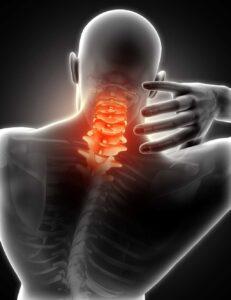
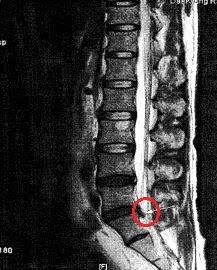
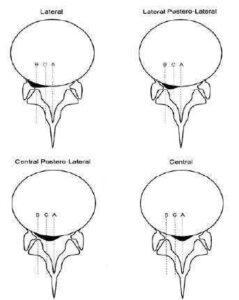
Many patients who visit us for back pain ask, “My legs aren’t tingling, so it couldn’t be a herniated disc, right?” However, what matters more than the pattern of pain is the collapsed structure of the spine.(Herniated Discs)
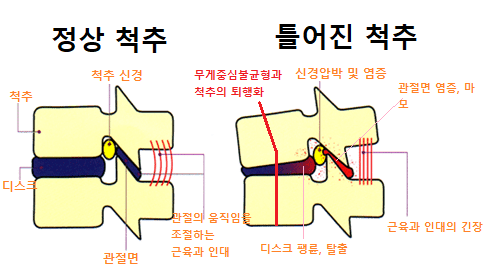
■ A Disc Without Leg Numbness Can Be More Dangerous
When the internal pressure of the disc (intervertebral disc) has increased but hasn’t directly touched the nerve roots yet, leg numbness does not occur. Instead, you feel a heavy, “breaking” pain in your lower back. Ignoring this signal can eventually lead to “structural collapse,” resulting in sudden paralysis or gait disturbances.
Correlation Between Lumbar Sprains and Herniated Discs
80% of untreated simple back sprains progress to a herniated disc.
Did you think a sudden “tweak” while lifting something would get better with a few days of rest? Statistics tell a different story.
- 8 out of 10 sprain patients experience a recurrence.According to data from the Health Insurance Review and Assessment Service, 60–80% of patients treated for acute lumbar sprains experience a recurrence within one year.
- Cumulative Damage:
- Acute Sprain: Damage to muscles and ligaments.
- Chronic Sprain: Spinal instability due to weakened ligaments.
- Herniated Disc: The nucleus pulposus escapes through the unstable vertebrae to compress nerves.
- Sosaeng’s Approach: “C0-C1 Remodeling”Frequent sprains mean your “axis has collapsed.” If the Upper Cervical spine (C0-C1), which balances the head’s weight, is misaligned, the lower back remains in a “pre-strained” state.
■ Summary: Spinal Health by the Numbers
- 84%: The percentage of the population that experiences severe back pain at least once.
- 40%: The percentage of disc patients who previously ignored “simple sprains.”
- 0.1mm: The tiny displacement of the Upper Cervical (C0-C1) spine that starts physical pressure on the lumbar discs.
■ Real Disc vs. Fake Disc
| Category | Real Disc (Active) | “Fake” Disc (Structural) |
| Status | Actual nerve compression/inflammation from leaking disc material. | Disc symptoms caused by spinal misalignment. |
| Analogy | An active volcano currently erupting lava. | A dormant volcano with lava inside but not erupting. |
| Test | Raising leg while prone (Impossible due to pain). | Leg raise is possible; pain changes based on head position. |
| Treatment | Focus on traction and medication over aggressive Chuna. | Primary indication for Chuna Therapy. |
■ Why Look at the Neck for Back Pain? The C0-C1 Key
The essence of Sosaeng Batae Chuna lies in the Upper Cervical spine (C0, C1).
- The Switch: C0 (Occiput) and C1 (Atlas) act as the “master equilibrium device.” If this is tilted, the body compensates by twisting the shoulders and pelvis.
- Descending Pattern: The lower back is simply the place that “bursts” because it is the final point enduring the shifted load of the head.
Why Sosaeng Korean Medicine Clinic?
- Focus on the “Switch”: While others look at the hurting back, we fix the starting point of the imbalance.
- Neurological Reset: C0-C1 is the gateway for the Brainstem and Vagus Nerve. Aligning this can improve autonomic issues like dry eyes or overactive bladder.
- High-Precision Technique: We use sophisticated, gentle pressure rather than forceful cracking to adjust the 0.1mm micro-displacements.
■ Comparison: C1-C2 vs. C0-C1
| Category | C1-C2 (Standard Chuna) | C0-C1 (Sosaeng Batae Chuna) |
| Primary Role | Neck rotation (turning side to side) | Horizontal/Vertical balance & Nerve gateway |
| Target | Range of motion & muscle tension | Nerve decompression & Whole-body remodeling |
| Effect | Improves neck pain and stiffness | Fundamental cure for Lumbar Discs; Autonomic help |
| Difficulty | Common technique | Requires highly skilled micro-alignment |
■ [Review] “I had no leg numbness, but it was a disc?”
Patient: 30s Office Worker
Symptoms: Chronic back pain for 3 years. Difficulty bending over to wash his face. MRI showed early disc issues.
Diagnosis: Severe misalignment of the C0-C1. The center of gravity was shifted forward, overloading the lower back.
Result: After C0-C1 adjustment and Miniscalpel (Acupotomy) therapy, the patient reported his “eyes felt clearer” and the recurring back tweaks stopped entirely.
■ Chuna Therapy Cost (Health Insurance Applied)
As of 2019, Chuna is covered by Health Insurance (up to 20 times per year).
| Type | Total Cost (Approx.) | Out-of-pocket (General) |
| Simple Chuna (Muscle relaxation) | 21,402 KRW | 10,700 KRW |
| Complex Chuna (Joint alignment) | 36,145 KRW | 18,000 KRW~ |
※ Co-payment may be lower for diagnosed Disc or Stenosis. Auto accident insurance covers 100% of the cost.
“Don’t let today’s sprain become tomorrow’s disc surgery.”
Rebuild your spine from the foundation (Batae) at Sosaeng Korean Medicine Clinic.
Contact: 02-3472-7510
(Located near Mia-sa-geori Station)